It's no secret that most new businesses fail within the first 10 years. It's easy to blame this on dips and slumps in the economy. But economic winters don't kill businesses; lack of preparation does.
The most successful companies in the world thrive in uncertain times. Over half of the Fortune 500 companies were launched during recessions. Why? Because the leaders behind those companies didn't shrink in tough times—they innovated and optimized. If you can apply the same principles they did, you'll dominate in any market.
In this two-part series, we'll uncover the 7 Forces of Business Mastery—the foundational strategies that will empower you to:
Optimize your business for efficiency and scale
Uncover and unleash your true competitive advantage
Master the power of anticipation
Develop loyal clients who stay with you for life
This is more than theory. These are battle-tested strategies based on principles from our Business Mastery event and Business Accelerator training.
1. Ditch the business plan and create a business MAP
A business plan is no longer sufficient to guide you to the next level. Disruptive technologies or new competitors can upend your business seemingly overnight. You don't need a static document. You need a business MAP: a Massive Action Plan that keeps you laser-focused on your outcomes, flexible in your approach, and primed to pivot when disruption hits.
To build your MAP, start with these three essential questions:
What business am I really in?
Most entrepreneurs answer this on a surface level. But successful companies dig deeper. Starbucks began to thrive when they acknowledged that they were not just in the coffee business but in the business of bringing people together. Disney doesn't just sell entertainment—they sell unforgettable experiences. Domino's is not in the pizza business—they are in the convenience and delivery business. You must define the real business you're in to align your strategy, marketing, and product delivery with what truly matters to your clients.
Digital distractions are not going away. The leaders who rise above the competition will be the ones who learn to take control of their focus and, therefore, their time and energy.
When you move from operator to owner, the business starts to breathe. Your team stops waiting and starts leading. The company’s results become less dependent on your mood, energy, and availability. You get time back, and you regain the ability to think.
What is the greater purpose that drives this business?
What led you to start your business in the first place? Why are you in it now? Purpose is power. It's what wakes you up at 5 AM and keeps you going when the pressure's on. Your team needs to feel it. Your clients need to believe in it. Tesla's purpose is to "create a sustainable future for humanity." Microsoft's vision is "empowerment through technology." Define the mission that will attract talent, drive innovation, and retain loyal customers for years to come.
Where am I now, and where do I want to go?
Clarity is the beginning of mastery. You can't build a roadmap if you're not honest about your starting point. Identify your strengths, pinpoint your weaknesses, and get radically clear on the gap between where you are and where you need to be.
2. Strategic innovation to provide more value than anyone else
The market will always be looking for something new. Make sure you are providing innovation, not a competitor. If you want an example of what happens to companies that don't innovate, look to Blockbuster.
In 2000, Blockbuster was the king of movie rentals. Netflix was an afterthought. But while Blockbuster doubled down on late fees, Netflix focused on convenience and innovation, redesigning the entire entertainment market. Blockbuster didn't change, and within a few years, they were gone.
Innovation doesn't have to be high-tech. It could be a new system, a new delivery method, or a new way of connecting with your clients. The key is strategic innovation—targeted, intentional, and focused on one thing: delivering more value than anyone else in your space.
Embed innovation into your culture. Make it everyone's responsibility—not just the leadership team's. The moment you stop innovating is the moment you start dying.
3. Become a world-class marketer
Marketing is not about selling a product. It's about understanding people at a deeper emotional level and speaking directly to their needs, desires, and identities.
To market with mastery, you must own these fundamentals:
Know your customer better than they know themselves.Don't just sell to what they say they want. Anticipate what they need. "People don't buy products, they buy feelings." Every human being is driven by six core needs: certainty, variety, significance, love/connection, growth, and contribution. Understand which of those needs your product taps into. Lean into it, and you'll create demand without pushing.
Tell your core story.The most powerful marketing tells a story—your story. A compelling origin story rooted in purpose and vision invites clients to be part of something bigger than a transaction. People don't just buy from you, they join you.
Know your business inside and out.You can't afford to be fuzzy about your offer. Know what differentiates you. Be able to answer any question. We live in a world that demands clarity. Make sure your marketing provides it.
4. Dominate with sales mastery systems
Marketing drives interest. But sales is where the money is made.
If you're serious about growth, you need systems for capturing, converting, and closing leads consistently and predictably.
Here's the key: great salespeople aren't just trained. They're found. Look for hunger. Look for passion. Look for people who love people. Then train them with precision in the art of selling your product and services—because even natural talent needs tools and structure to perform at the highest level.
Create a culture of measurement and constant improvement. Track your close rates, identify bottlenecks, and adjust your approach or your team when needed. Sales is not a guessing game. It's a science, and mastery requires feedback and relentless follow-through.
Get the right coach in your corner
Knowledge alone isn't power. Applied knowledge is power.
It's easy to read strategies like this and nod your head. It's a different game entirely to implement them at a world-class level. That's why the best performers in every field, from athletes to executives, work with coaches.
A professional executive coach helps you see blind spots. They hold you accountable to your vision. They challenge your limitations and keep your standards high. Most of all, they accelerate your path to results.
Whether you're leading a small business or scaling a global brand, the right coach is one of the smartest investments you can make.
In part two, we'll break down the final three forces of Business Mastery—plus a foundational bonus force that underpins everything.
Video
Infographic
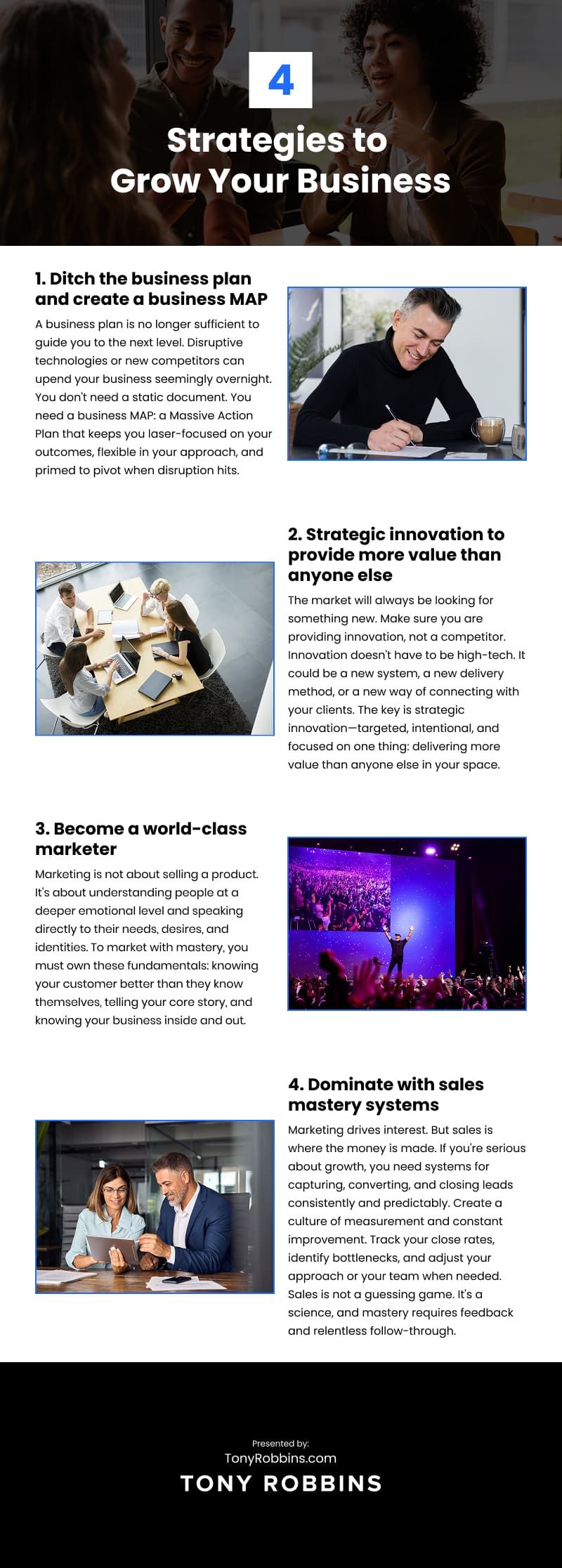
Most businesses don't fail because of economic downturns—they fail because they can't adapt under pressure. Long‑term survival depends on preparation and agility, not a rigid, outdated business plan. Discover four strategies that will help your business grow in this infographic.
4 strategies to grow your business in any market | Tony Robbins